Author: Robert R. Allard
| Source: Apostles of Divine Mercy
A Sign of Hope: Jesus, The Divine Mercy
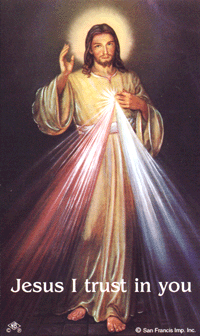
Jesus, I trust in you!
Jesus surely knew what he was doing when he gave us the Divine Mercy image.
The economy, the uneasiness associated with terrorism, wars and rumors of
wars, natural disasters. Everybody is looking for signs of hope. The Lord
has already provided for everything that we need today.
People often wonder where the Divine Mercy image came from, but a more important
question would be “why did Jesus give us this image, what does it portray,
and why now in this time?”
When Jesus appeared to Saint Faustina in 1931, Our Lord came with an incredible
message of hope. He told her about many things, but the central point was
that he wanted to pour out his mercy in abundance before he comes again to
judge the world. Our Lord said to her “Paint an image according to the pattern
that you see, with the signature: Jesus, I trust in you! I promise that
the soul that will venerate this image will not perish. I also promise victory
over its enemies…. especially at the hour of death. I Myself will defend
it as My own glory”. (Diary, entry #48)
These are great promises of salvation and hope, but that is not all. Jesus
gave us much more to hope for. Jesus told Saint Faustina that he wanted
a special feast celebrated in the Church on the first Sunday after Easter
where he would pour out his mercy. Jesus said to her “I desire that there
be a Feast of Mercy. I want this image, which you will paint with a brush,
to be solemnly blessed on the first Sunday after Easter; that Sunday is to
be the Feast of Mercy”. (Diary, entry #49)
Of all the things that Our Lord asked her to write down in her diary, the
Feast of Mercy was the most important. Why? Because the Feast of Mercy
gives us the greatest hope of all: a direct entry into eternal life in Heaven
on that day. Jesus promised the complete forgiveness of all sins and all
punishment to anyone who would go to confession and receive Holy Communion
on that feast. What could bring us more hope in the world that we live in
today, than that incredible promise?
The Divine Mercy image that Jesus asked to be blessed and venerated on that
feast is an image of hope. It is an icon to draw us into the Sacraments
of Confession and Holy Communion with great trust. It is the perfect representation
of those sacraments with its light rays symbolizing the life blood and water
that poured forth from our Savior’s heart when Jesus was pierced on the Cross.
When we look at the image, we are to imagine that blood and water cleansing
us from our sins.
Pope Benedict XVI wrote of such an image and the need to have one in every
church. He stated in his book ‘The Spirit of the Liturgy’ that the miss-understanding
of Vatican II and the removal of images has “left behind a void, the wretchedness
of which we are now experiencing.” He continued “The complete absence of
images is incompatible with faith in the Incarnation of God. God has acted
in history and entered our sensible world…. Images of beauty, in which the
mystery of the invisible God becomes visible, are an essential part of Christian
worship. The image of Christ is always an icon of the Eucharist, that is,
it points to the sacramental presence of the Easter mystery”.
He used about 20 pages in that book to set the record straight on images
in our sanctuaries. He went on to say “Where do we go from here?” and identified
the fundamental principles of an art ordered to divine worship and the importance
of images. He perfectly described every aspect of the Divine Mercy image
as the perfect icon, not only for the celebration of the Feast of Mercy,
which has been instituted in our Church as Divine Mercy Sunday, but for every
single liturgy.
If our Pope is calling for these images to be placed in our churches, who
are we to argue? Jesus surely knew what he was doing. Everything that the
Church needs right now has been given to us through modern day prophets:
Saint Faustina, Pope John Paul II, and now Pope Benedict. Only through our
obedience to the Magisterium will we all find the peace and hope that Our
Heavenly Father wants all of us to experience. We cannot turn our backs
on our dear Lord and Savior.
What are we to be obedient to? This is very simple. First of all we need
to look at the Church documents that are associated with Divine Mercy Sunday.
The most important of these are the decrees for the establishment of Divine
Mercy Sunday and the special plenary indulgence for that feast that was issued
in 2002 that states within it the “Duties of Priests”. This should come
as no surprise as this latter decree was published worldwide and made available
to all of the bishops.
To be specific, the “Duties of Priests” calls for all priests who exercise
pastoral ministry, and especially parish priests, to inform the faithful
in the most suitable way of the Church's salutary provision (plenary indulgence).
They should promptly and generously be willing to hear their confessions
(within several days, about 20, before or after the feast). On Divine Mercy
Sunday, after celebrating Masses, they should all lead the recitation of
the prayers for the indulgences, which are the Our Father, Apostles Creed,
a prayer for the Pope (that could be a Hail Mary) and also add a devout prayer
to the merciful Lord Jesus, such as “Merciful Jesus, I trust in you!"
It is important that we pay attention to the words in that decree, particularly
to the words “in the most suitable manner” as pertains to telling everyone
about the plenary indulgence. What good would it do, to wait until Mercy
Sunday to get the word out? The whole idea is to get the word out to everyone
before, especially to all of the Easter-only and Fallen-away Catholics that
are in mortal sin. There are many reasons why Jesus wanted this Feast of
Mercy on the Sunday after Easter, and getting the Easter-only Catholics back
must be a primary one. How else can we get these people back? The promise
of the total forgiveness of sins and punishment is an enticement of major
proportions and we should get serious about preaching about this on Easter
while we have them sitting there right under our noses. We can’t let them
perish into Hell for eternity!
The Easter-only and Fallen-away Catholics may be acting like everything is
fine, but deep within; they do not have peace or any hope. Only through
reconciliation with the Lord, will they find that peace and hope. Jesus
has given us everything that we need in this feast to make it all better.
He has given us this tremendous promise of the total forgiveness of sins
and punishment and Our Lord has given us his image, not only to get us to
approach the confessional with trust, but also to give us great hope for
the future. What could give us more hope, than a direct pass straight to
Heaven?
What should we do? Follow the Lord’s instruction. Get a Divine Mercy image
installed in your parish. Tell everyone about Divine Mercy Sunday, especially
all of the Easter-only Catholics. Put articles in the newspaper to reach
all of the other Luke-warm and Fallen-away Catholics. Do everything that
you possibly can, including on radio and TV. Don’t let anyone perish into
Hell for eternity. Jesus did tell Saint Faustina that the loss of each soul
plunges Him into mortal sadness
For more information, including an Easter Bulletin Insert go to www.MercySunday.com.
HOW TO PRAY THE DIVINE MERCY CHAPLET
1. Make the Sign of the Cross
2. Pray:
1 Our Father
1 Hail Mary
1 Apostles Creed
3. On the Our Father Beads say the following:
Eternal Father, I offer you the Body and Blood, Soul and Divinity of Your
dearly beloved Son, Our Lord Jesus Christ, in atonement for our sins and
those of the whole world.
4. On the 10 Hail Mary Beads say the following:
For the sake of His sorrowful Passion, have mercy on us and on the whole
world.
(Repeat steps 3 and 4 in all five decades).
5. Say three times:
Holy God, Holy Mighty One, Holy Immortal One, have mercy on us and on the
whole world.
The Divine Mercy Chaplet devotion dates back to 1933 when Our Lord Jesus
Christ appeared to Sister Faustina asking her to spread the devotion to his
divine mercy. Our Lord told Sister Faustina:
"Say unceasingly this chaplet that I have taught you. Anyone who
says it will receive great Mercy at the hour of death. Priests
will recommend it to sinners as the last hope. Even the most
hardened sinner, if he recites this Chaplet even once, will
receive grace from My Infinite Mercy. I want the whole world to
know My Infinite Mercy. I want to give unimaginable graces to
those who trust in My Mercy...."
"....When they say this Chaplet in the presence of the dying, I
will stand between My Father and the dying person not as the just


 Jesus, I trust in you!